P2
构建弹簧网络
P6
Structured Spring Networks
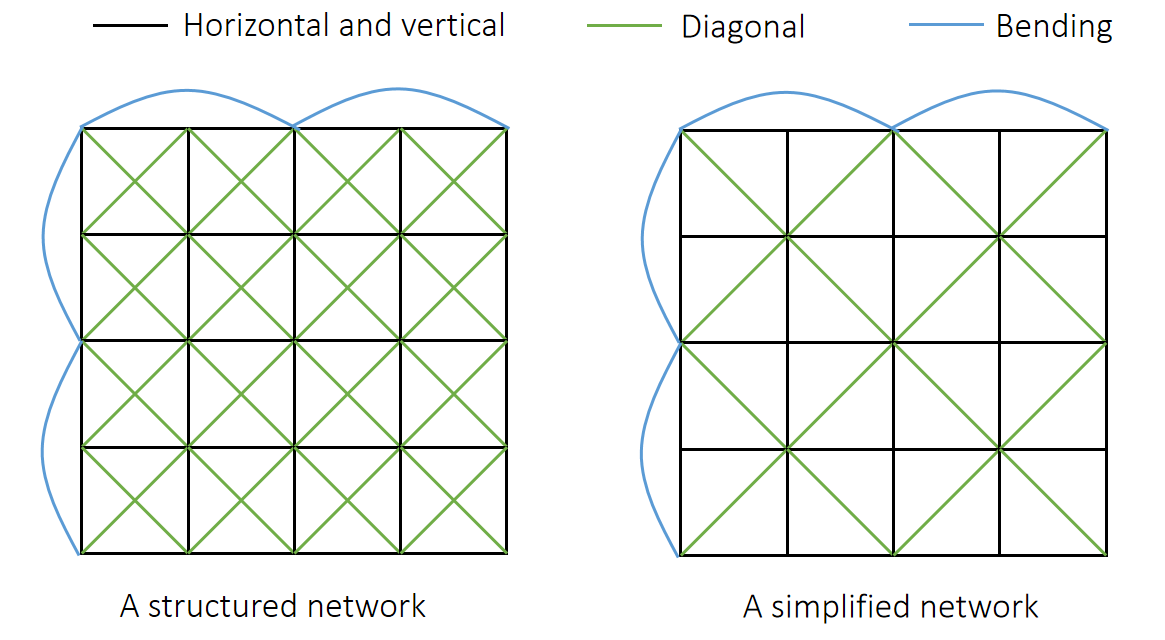
✅ 绿线:防止斜方向的拉伸。蓝线:防止翻折。
P7
Unstructured Spring Networks
We can also turn an unstructured triangle mesh into a spring network for simulation.
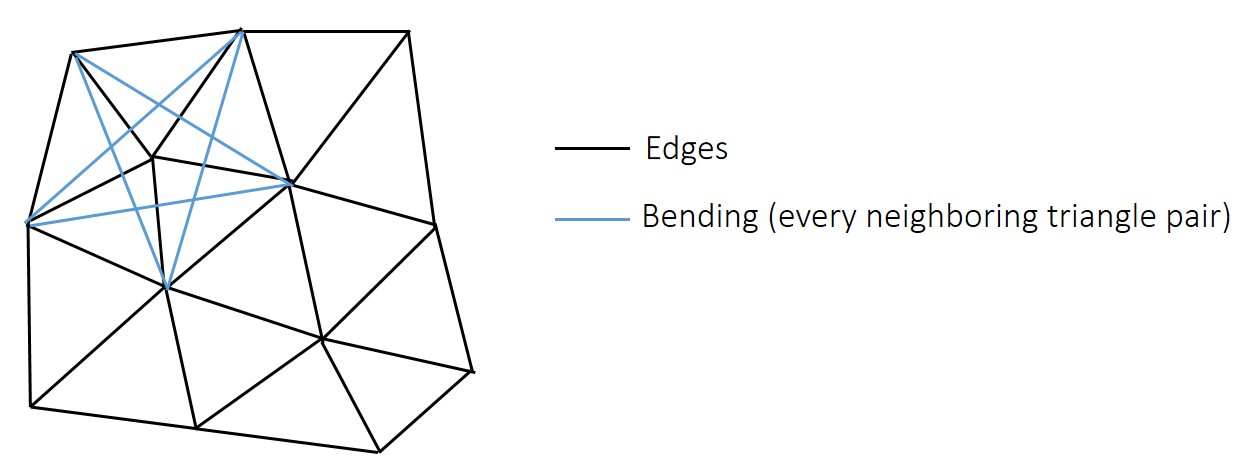
✅ 蓝线:抵抗弯曲。对每条内部边,加这样一根弹簧。
P8
怎样基于三角形Mesh增加蓝线弹簧
The basic representation of a triangle mesh uses vertex and triangle lists.
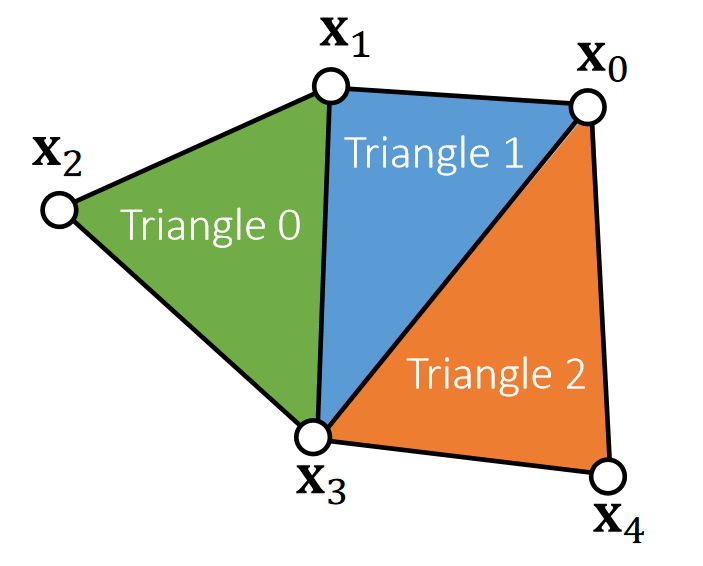
✅ 已知边的信息,需找出内部边,例如\(\mathbf{x}_0\mathbf{x}_3\),因此要基于此构造边:\(\mathbf{x}_1x 4\)
✅ Each triangle has three edges. But there are repeated ones. Repeated edges就是内部边。
✅ 1. 找出内部边。2. 找出内部边所属于的两个三角形。3. 找出两个三角形上不在这条内部边上的点。4. 连续一根弹簧。
Vertex list: {\(\mathbf{x} _0, \mathbf{x}_1, \mathbf{x}_2, \mathbf{x}_3, \mathbf{x}_4\)} (3D vectors)
Triangle list: {1, 2, 3, 0, 1, 3, 0, 3, 4} (index triples)
The key to topological construction is to sort triangle edge triples.
Each triple contains: edge vertex index 0, edge vertex index 1 and triangle index (index 0<index).
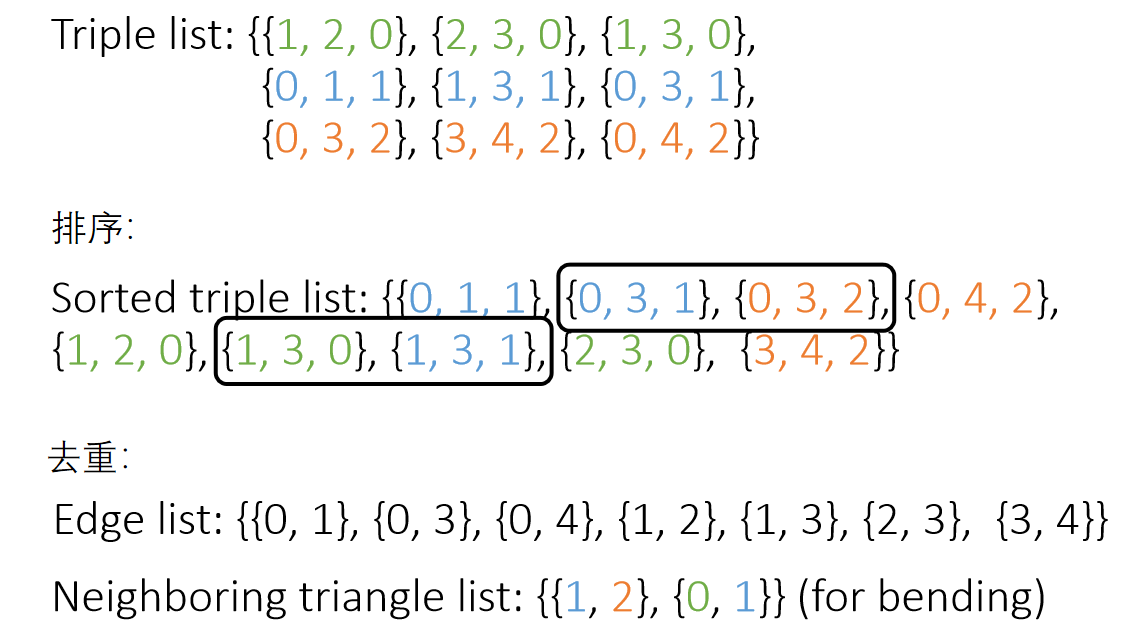
✅ 排序:基于边排序,排序后相同边会靠在一起
本文出自CaterpillarStudyGroup,转载请注明出处。
https://caterpillarstudygroup.github.io/GAMES103_mdbook/