P66
Conditional Generation and Guidance
P67
✅ 通常需要的是特定的生成,而不是随意的生成。因此需要通过control引入特定的需求。
以下是文生图的例子:
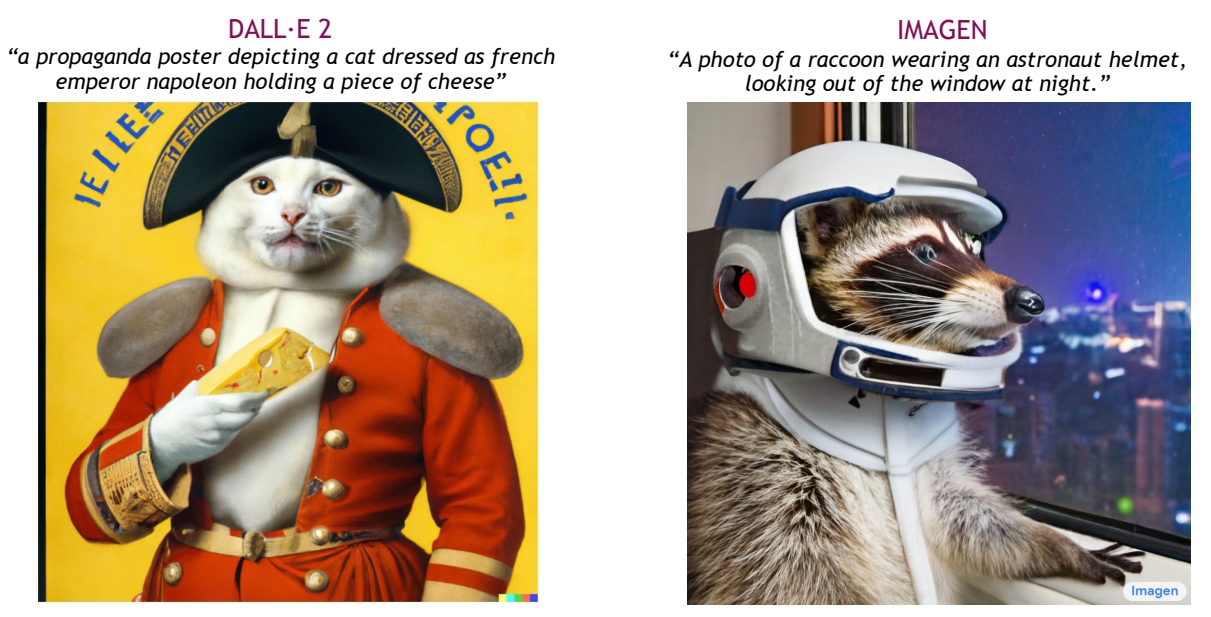
Ramesh et al., “Hierarchical Text-Conditional Image Generation with CLIP Latents”, arXiv 2022.
Saharia et al., “Photorealistic Text-to-Image Diffusion Models with Deep Language Understanding”, arXiv 2022.
P68
Conditioning and Guidance Techniques
Explicit Conditions
Classifier Guidance
Classifier-free Guidance
P69
Explicit Conditions
P70
Conditional sampling can be considered as training \(p(\mathbf{x} |\mathbf{y} )\) where \(\mathbf{y}\) is the input conditioning (e.g., text) and \(\mathbf{x}\) is generated output (e.g., image)
Train the score model for \(\mathbf{x}\) conditioned on \(\mathbf{y}\) using:
$$ \mathbb{E} _ {(\mathbf{x,y} )\sim P\mathrm{data} (\mathbf{x,y} )}\mathbb{E} _ {\epsilon \sim \mathcal{N}(\mathbf{0,I} ) }\mathbb{E} _{t\sim u[0,T]}||\epsilon _ \theta (\mathbf{x} _ t,t;\mathbf{y} )- \epsilon ||^2_2 $$
The conditional score is simply a U-Net with \(\mathbf{x}_t\) and \(\mathbf{y}\) together in the input.
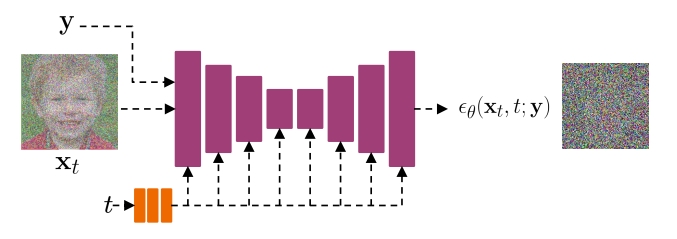
✅ 需要 \((x,y)\) 的 pair data.
P71
Classifier Guidance
P72
Bayes’ Rule in Action
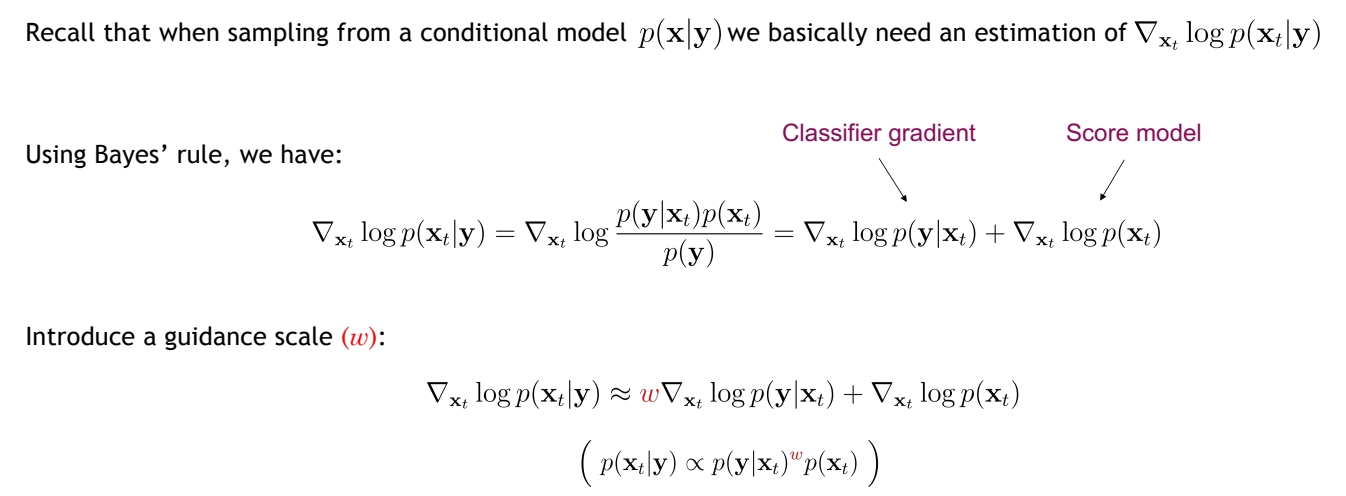
✅ \(p(y)\) 与 \(\mathbf{x} _ t\) 无关,因此可以去掉。
训练方法
✅ 第一步:需要一个训好的p(x)的 diffusion model 。
✅ 第二步:训练一个分类网络,输入xt能够正确地预测控制条件(y不一定是离散的类别)。
✅ 第三步:取第二步的梯度,用一定的权重\(w \)结合到第一步的forward过程中。\(w \)决定分类器的影响力。
✅ 只需要部分pair data和大量的非pair data。但需要单独训练一个分类器。
相关论文
| ID | Year | Name | Note | Tags | Link |
|---|---|---|---|---|---|
| 2021 | Controllable and Compositional Generation with Latent-Space Energy-Based Models | ||||
| 2021 | Diffusion models beat GANs on image synthesis |
Classifier-free Guidance
| ID | Year | Name | Note | Tags | Link |
|---|---|---|---|---|---|
| 2021 | Classifier-Free Diffusion Guidance | link |